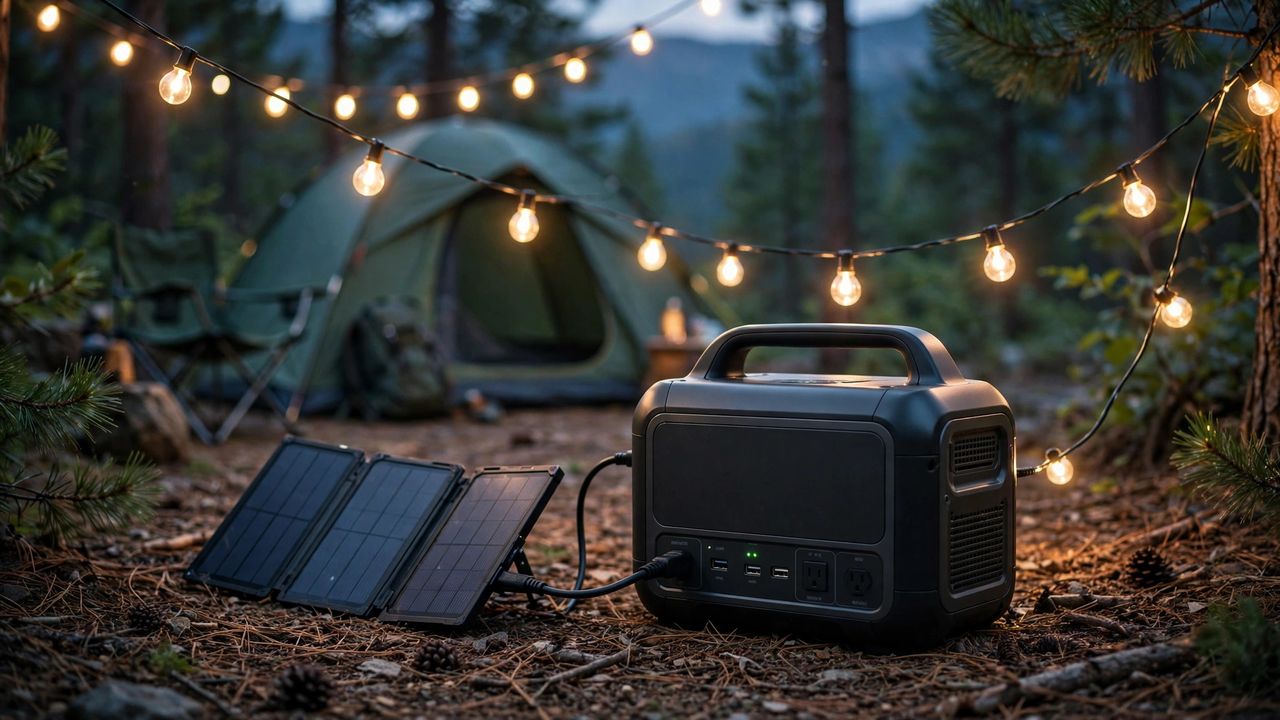
A solar generator — really a big battery with solar charging — brings silent, fume-free power to your campsite. No gas, no noise complaints, just charged phones, lit tents, and cold drinks. Picking the right size and panel setup is the difference between a trip powered by the sun and one powered by regret.
Size It to Your Watt-Hours
List what you will run and for how long: a phone is ~15Wh per charge, a laptop ~60Wh, a 12V cooler ~40Wh per hour, and a CPAP ~40–60Wh per night. Add it up, then buy a station with 1.5× that capacity so you have a cloudy-day buffer. Buy for your real load plus 50% headroom — undersizing is the most common camping regret.
Match the Solar Panel to the Station
A generator charges as fast as its panel input allows. A 500Wh station pairs well with a 100W panel; a 1000Wh+ station deserves 200W or more. Foldable monocrystalline panels pack small and perform best in real-world light. The panel matters as much as the battery — a big battery with a tiny panel recharges too slowly to keep up.
Battery Chemistry: LiFePO4 Wins in 2026
Lithium iron phosphate (LiFePO4) batteries now dominate mid-range and premium stations, offering 3,000–4,000 charge cycles versus ~800 for older lithium-ion — roughly a decade of camping instead of three seasons. They are also more stable in heat. For a station you will use for years, LiFePO4 is worth every extra dollar.
Ports, Weight and Pass-Through Charging
Check for the ports you actually need: USB-C PD for laptops, a 12V car socket for coolers, and enough AC outlets for your gear. Pass-through charging lets you charge the station from solar while it powers your devices — essential on multi-day trips. Keep weight under what you will happily carry from the car. Pass-through charging turns one sunny day into unlimited runtime for small loads.
With the right capacity, panel, and LiFePO4 battery, a solar generator becomes the quiet hero of every trip. Size it honestly, charge it daily, and enjoy off-grid power without the generator roar.