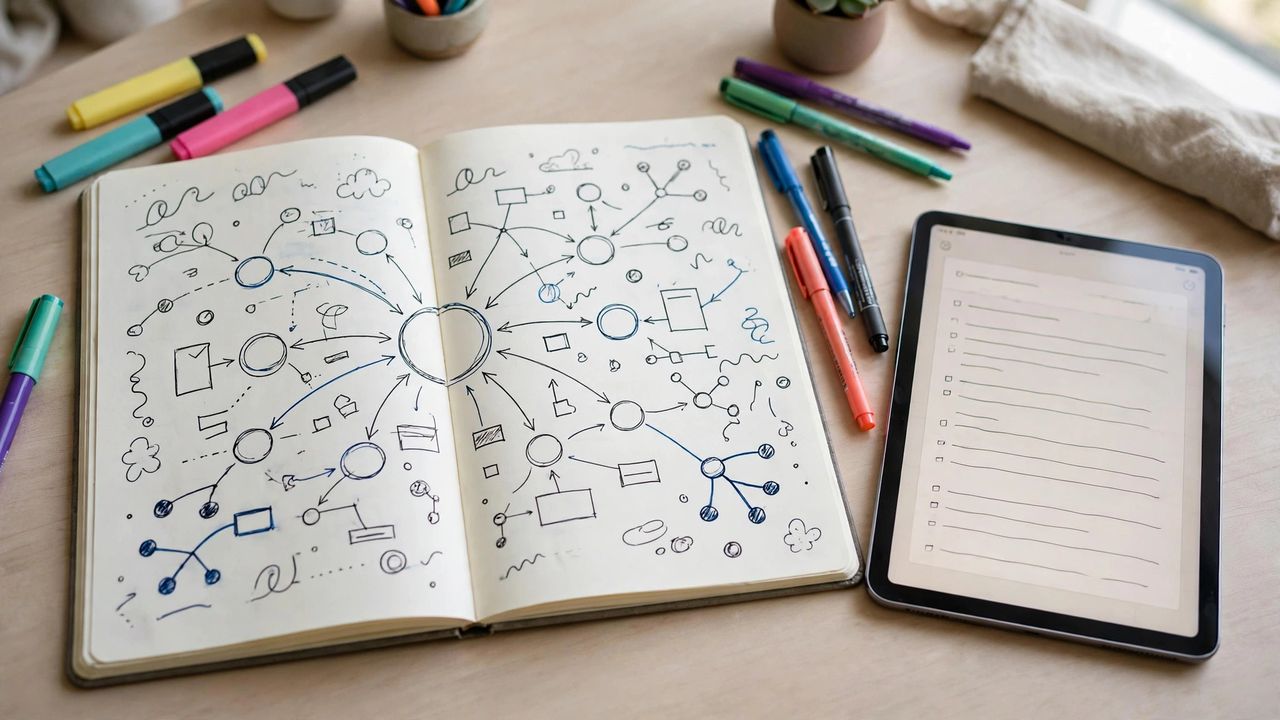
Most people take notes by copying down everything — then never read them again. The method you use shapes how well you remember, organize, and actually use information. Here's a clear comparison of the best note-taking methods in 2026, paper and digital alike.
The Cornell method: best for lectures and study
Divide your page into three zones: main notes on the right, key questions and cues on the left, and a summary at the bottom. Reviewing becomes easy — cover the right column and quiz yourself from the cues. Cornell notes turn passive listening into built-in self-testing, which is why they dominate exam prep.
Mind mapping: best for brainstorming and big pictures
Start with a central idea in the middle of the page and branch outward with related concepts, colors, and images. It mirrors how your brain links ideas and makes creative connections visible. When a topic feels like a tangled mess, a mind map untangles it faster than any linear list.
Zettelkasten: best for writers and researchers
Write one idea per note, give each a clear title, and link notes together like a personal wiki. Over months this becomes a thinking partner that resurfaces forgotten insights. Zettelkasten rewards consistency — the magic appears after a hundred linked notes, not ten.
Digital tools: best for search and sync
Modern note apps bring instant search, cloud sync across devices, and handwriting or audio capture. Choose based on your workflow: simple and fast for daily notes, or powerful linking for research. The best app is the one you'll open daily — features mean nothing if the tool feels like a chore.
There's no single best method — there's the one that matches your goal. Use Cornell for classes, mind maps for planning, linked notes for long-term thinking, and digital tools to keep it all searchable in 2026.