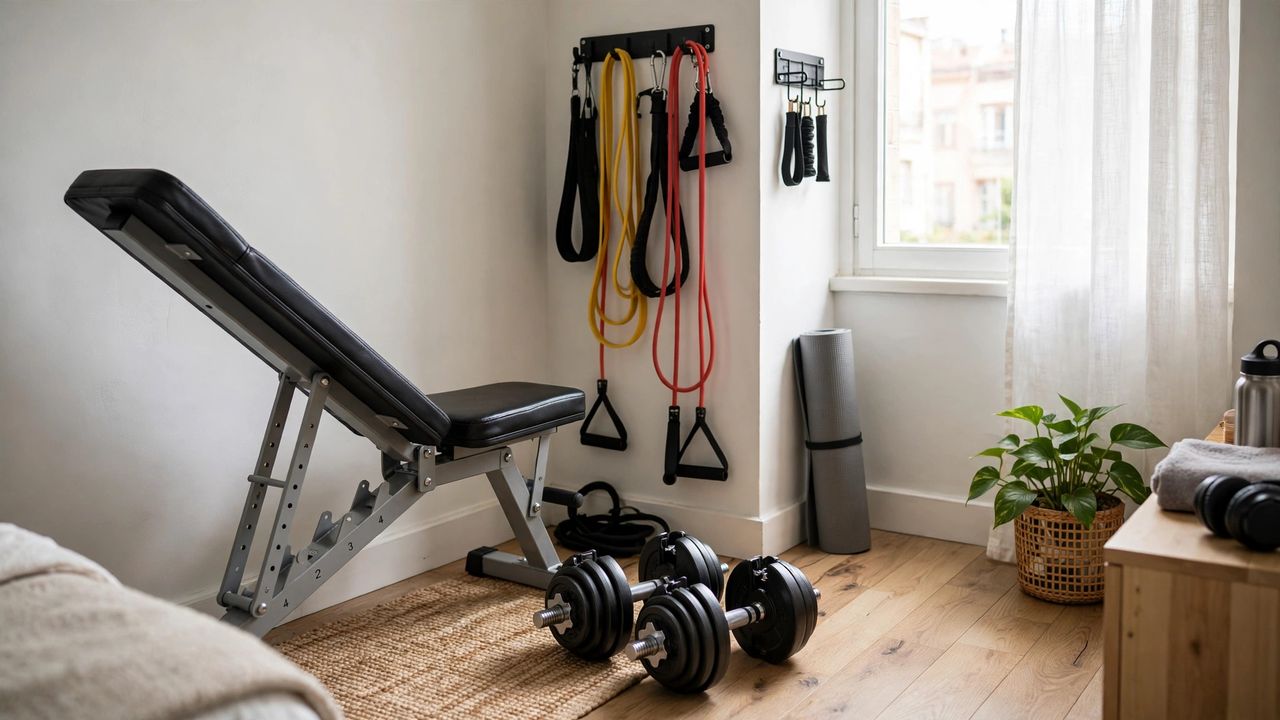
You do not need a spare room or a big budget to train seriously at home. In 2026, smart, compact equipment can replace an entire commercial gym in the corner of your bedroom. Here is exactly what to buy — and what to skip.
Start with the big three
Three items cover nearly every muscle group: adjustable dumbbells (replacing 15+ fixed pairs), a sturdy adjustable bench, and a pull-up bar that fits a doorframe. This trio costs less than one year of gym membership and handles pressing, rowing, squatting, and pulling. Buy these first before anything else.
Add resistance bands and a kettlebell
Resistance bands are the best value in all of fitness: cheap, silent, and they fit in a drawer. They add variety to every lift and make warm-ups safer. One heavy kettlebell (16–24 kg) unlocks swings, goblet squats, and carries — the highest return per square meter of any single item.
Flooring and the small-space setup
A pair of interlocking rubber mats protects your floor and your downstairs neighbors. Arrange equipment along one wall so you can fold or stack everything in five minutes. Wall-mounted racks and fold-flat benches are worth the premium in apartments — space you cannot use is equipment you will not touch.
What not to buy
Skip the bulky all-in-one machines and cheap cardio gadgets that become expensive clothes racks. A treadmill is only worth it if you will genuinely run daily — most people will not. And never buy equipment before you have a consistent 3-day routine; motivation must come before machines, not after.
Start with dumbbells, a bench, and a pull-up bar. Train consistently for three months, then add one item at a time. The best home gym is the one you actually use — and the simplest setup is the easiest to use.