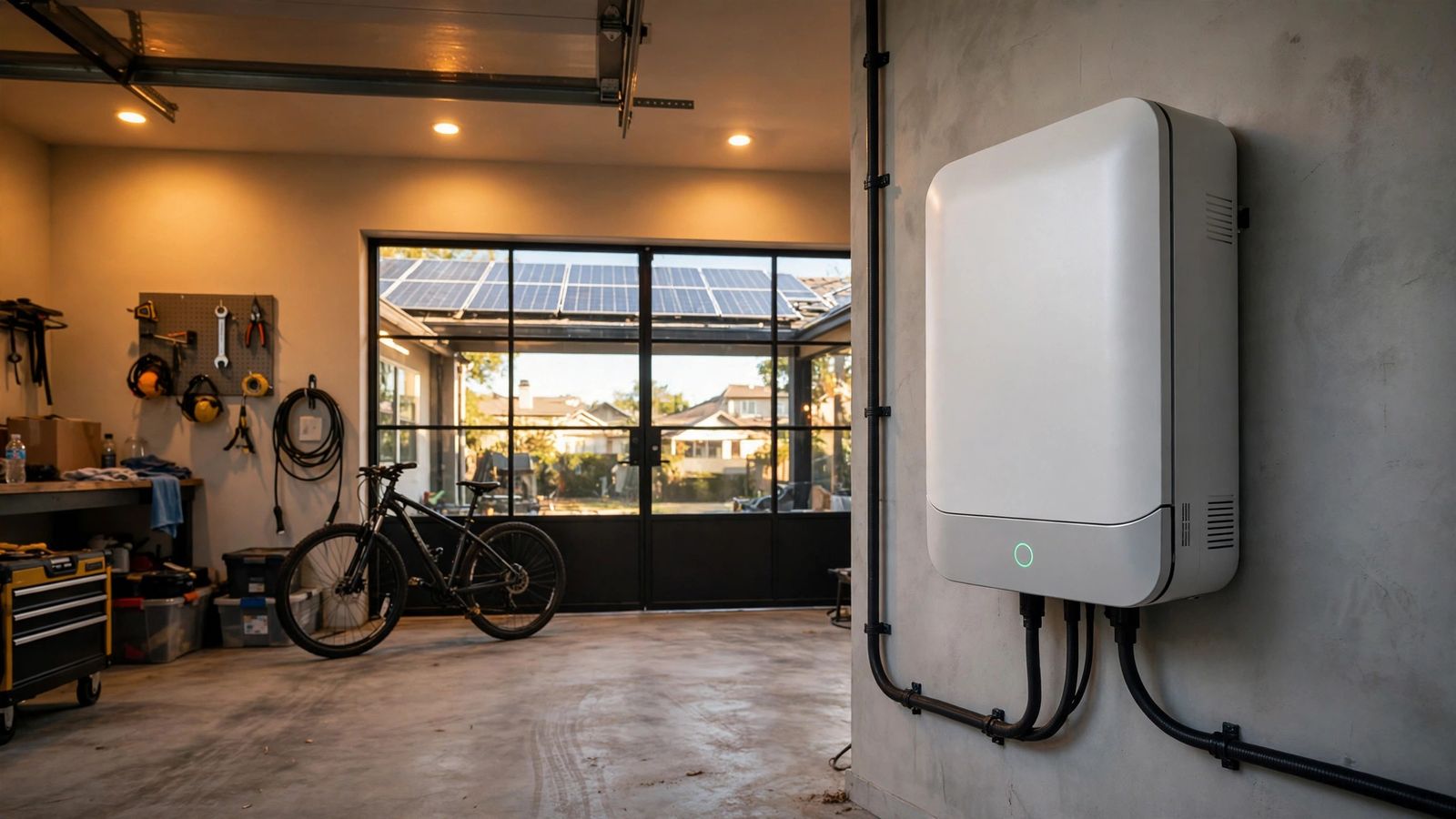
Storms are stronger, grids are stressed, and a blackout at the wrong moment can spoil your food, kill your Wi-Fi, and stop your medical devices. A home battery stores electricity for exactly those moments — silent, automatic, and with zero fuel. A home battery turns a blackout from an emergency into a minor inconvenience.
How Home Batteries Work
A lithium battery (usually 10–15 kWh for a typical home) charges from your solar panels or from the grid during cheap off-peak hours. When the power fails — or when peak prices kick in — it switches over in milliseconds, powering your fridge, lights, Wi-Fi, and outlets. Paired with solar, it can even run your home indefinitely during sunny outages. Think of it as a giant power bank for your whole house.
What It Actually Costs in 2026
A popular 13.5 kWh battery costs around $8,000–$12,000 installed, with federal and local incentives often cutting 30% off. The math improves if your utility charges time-of-use rates: the battery buys cheap night power and avoids expensive evening peaks. Some utilities even pay you to share your stored power during grid emergencies. Check your utility's time-of-use rates first — they decide how fast the battery pays for itself.
Battery vs. Gas Generator
Generators are cheaper up front but noisy, smelly, need fuel storage, and can't run indoors. Batteries are silent, maintenance-free, switch over instantly, and have no emissions. For short-to-medium outages (hours to a couple of days), batteries win comfortably; for week-long outages, a generator still has the edge. No fuel runs, no pull cords, no carbon monoxide — batteries just work.
Sizing and Buying Tips
List your must-run loads (fridge, freezer, Wi-Fi, phone chargers, a few lights) and add their watt-hours — that's your minimum size. Lithium iron phosphate (LFP) batteries last 10–15 years and are the safest chemistry for homes. Get an installer certified by the battery maker to keep the warranty valid. Buy for your essential loads first; you can add a second battery later.