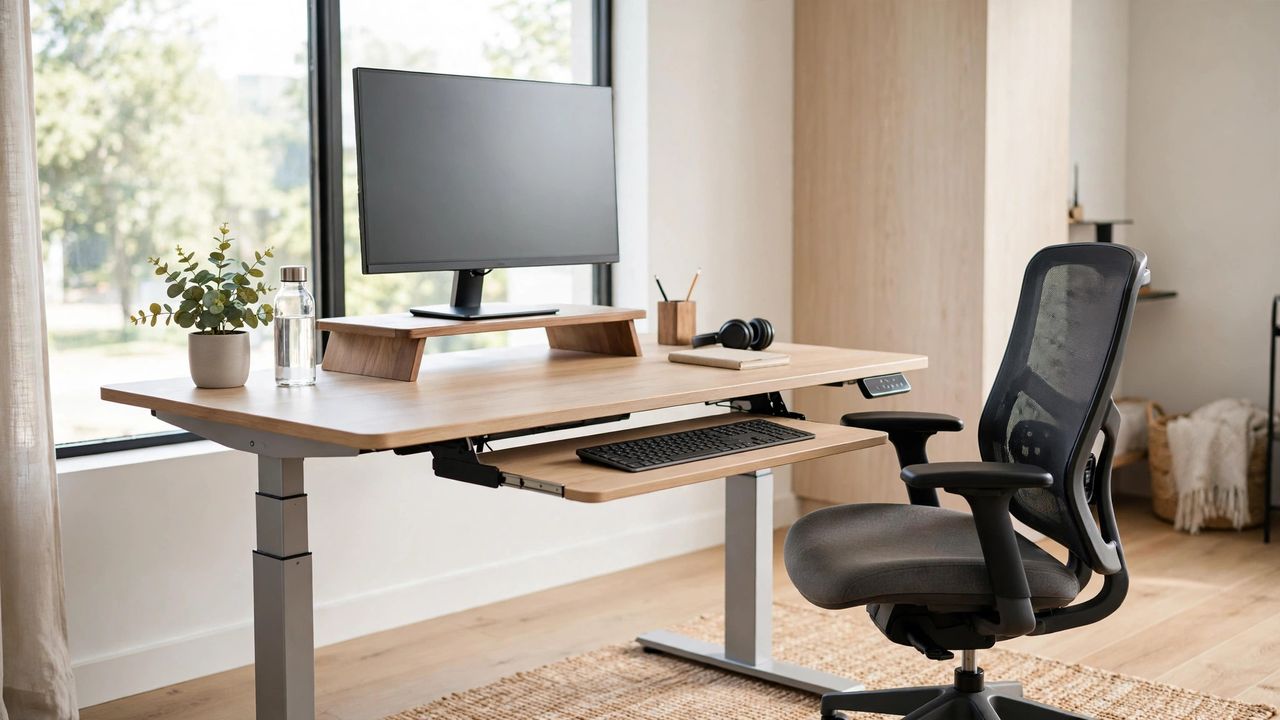
If you work from home and end every day with a stiff neck and sore lower back, your desk is the problem — not you. The good news: a truly ergonomic desk setup doesn't require a $1,500 chair. With a few adjustments and under $100 in accessories, you can build a pain-free home office this week.
The Chair: Your Most Important Investment
Sit all the way back so your lower back touches the backrest — a rolled-up towel works as lumbar support. Your feet should rest flat on the floor with knees at roughly 90 degrees; if your feet dangle, add a footrest or a stack of books. Armrests should let your shoulders relax — if they push your shoulders up, lower or remove them. Your hips should sit slightly above your knees, which opens the hip angle and takes pressure off your lower spine.
Monitor and Keyboard Positioning
Your monitor's top edge should sit at or just below eye level, about an arm's length away (20–28 inches). If you're craning your neck down at a laptop, a $30 laptop stand plus an external keyboard is the single best upgrade you can make. Keep your keyboard and mouse at elbow height with wrists straight and neutral — floating your hands is better than resting your wrists on a hard edge. The mouse should sit close to your body so your shoulder doesn't reach.
The 2026 Extras: Standing and Light
Sit-stand desks are cheaper than ever, and alternating every 30–60 minutes is one of the best things you can do for your back. If a desk converter is out of budget, simply stand for phone calls. Don't forget lighting: position your screen perpendicular to windows to avoid glare, and add a bias light behind the monitor to reduce eye strain during long days.
Cheap Fixes That Actually Work
A $15 lumbar roll, a footrest made of stacked boxes, monitor risers made of books — ergonomics is about geometry, not gadgets. Set a timer to stand and walk for 2 minutes every half hour; movement is the real ergonomic secret. Start with one change today, add another each week, and within a month your body will notice the difference.
A pain-free home office isn't a luxury — it's how you protect the body you work with every day. Measure twice, adjust once, and let your chair do the work your muscles were doing.